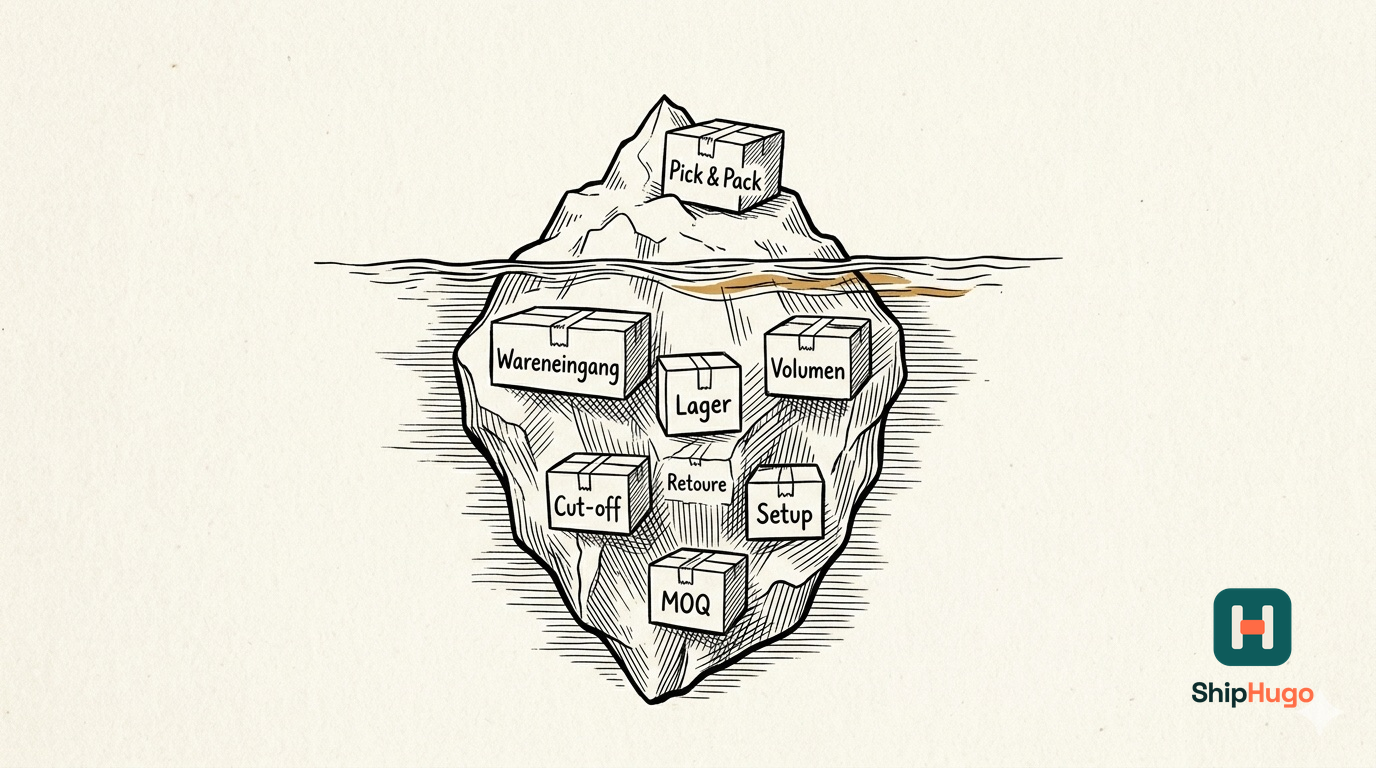
Ask your fulfillment partner for the Pick & Pack price and you hear a single number. Open the invoice a quarter later and suddenly there are five. The line items that eat into your margin never come up in the sales pitch — they hide in Appendix B, in the June rate update, or in a minimum-volume clause.
Here are seven fees that reliably hurt your margin — along with the mechanics behind each one.
Why the invoice is an iceberg
At the very top, visible to everyone, sits Pick & Pack. It's what gets advertised, because the per-unit figure looks small: between 1.20 and 2.50 euros per standard shipment is the market norm. But below the surface sit the recurring cost blocks that pile on month after month — the ones you usually don't really feel until your third quarterly close.
Do the math properly and every single fee flows into the calculation per unit shipped. That's the only way to get a comparable per-unit price.
1. What goods-in costs
Your delivery arrives at the warehouse and doesn't land on the shelf by magic. It gets unloaded, counted, inspected, scanned, booked in and moved to its storage slot. That's manual labor, and it shows up on the invoice — usually per pallet, per carton or by the hour.
Show up with loose mixed pallets — unlabeled cartons, wildly mixed SKUs, no master data — and it gets expensive, easily three to five times a clean goods-in. A serious provider expects an advance shipping notice (the heads-up before delivery), packing lists, EAN-coded cartons and single-SKU pallets. Deliver that way and you land at 0.50 to 1.50 euros per carton. Show up chaotic and it's 5 to 15 euros.
2. Storage costs — m³ or storage slot
This is where most people miscalculate. There are two billing models:
Storage-slot model: you pay for every slot you rent, whether or not it's full. That's easy to plan for, but you also pay for empty space once the season picks up.
Volume model (m³): here you only pay for what's actually occupied. That's fair, but the amount fluctuates.
The catch is in how it's measured: some providers calculate gross, based on the outer dimensions of your carton including the void fill. Others calculate net — based on the pure product volume with a buffer surcharge on top. The difference between the two approaches quickly adds up to 30 to 50 percent, and that's in the same warehouse. When you compare providers, the question “How exactly do you measure?” weighs more than any quoted rate.
3. Volumetric weight — the perennial one
A 1 kg parcel doesn't cost you shipping for 1 kg once it takes up a lot of volume. Carriers like DHL, DPD and GLS calculate using volumetric weight (sometimes called freight weight or chargeable weight): length times width times height in centimeters, divided by 5'000 (that's DHL and DPD), and by 4'000 or 6'000 with some services.
As soon as a product is light but bulky — think yoga mats, lampshades, voluminous boxes — the volumetric weight kicks in instead of the actual weight. The real weight simply stops mattering once the volumetric figure comes out higher. Take a parcel of 60×40×30 cm and the 5'000 divisor: that gives a volumetric weight of 14.4 kg. A 0.8 kg item inside it still gets billed as a 14.4 kg shipment — a factor of 18 between what's inside and what you pay.
Leave this effect out of your per-unit calculation and you'll keep pricing yourself too low. So before you sign: sample it, have a few shipping labels printed live and cross-check the actual weights.
4. Fuel, energy, tolls
Carrier surcharges for fuel are neither invented nor a fixed amount — they shift month to month. DHL, DPD and GLS publish their fuel surcharges on their websites and tie them monthly to mineral-oil prices. Right now they mostly sit between 6 and 12 percent on top of the shipping price.
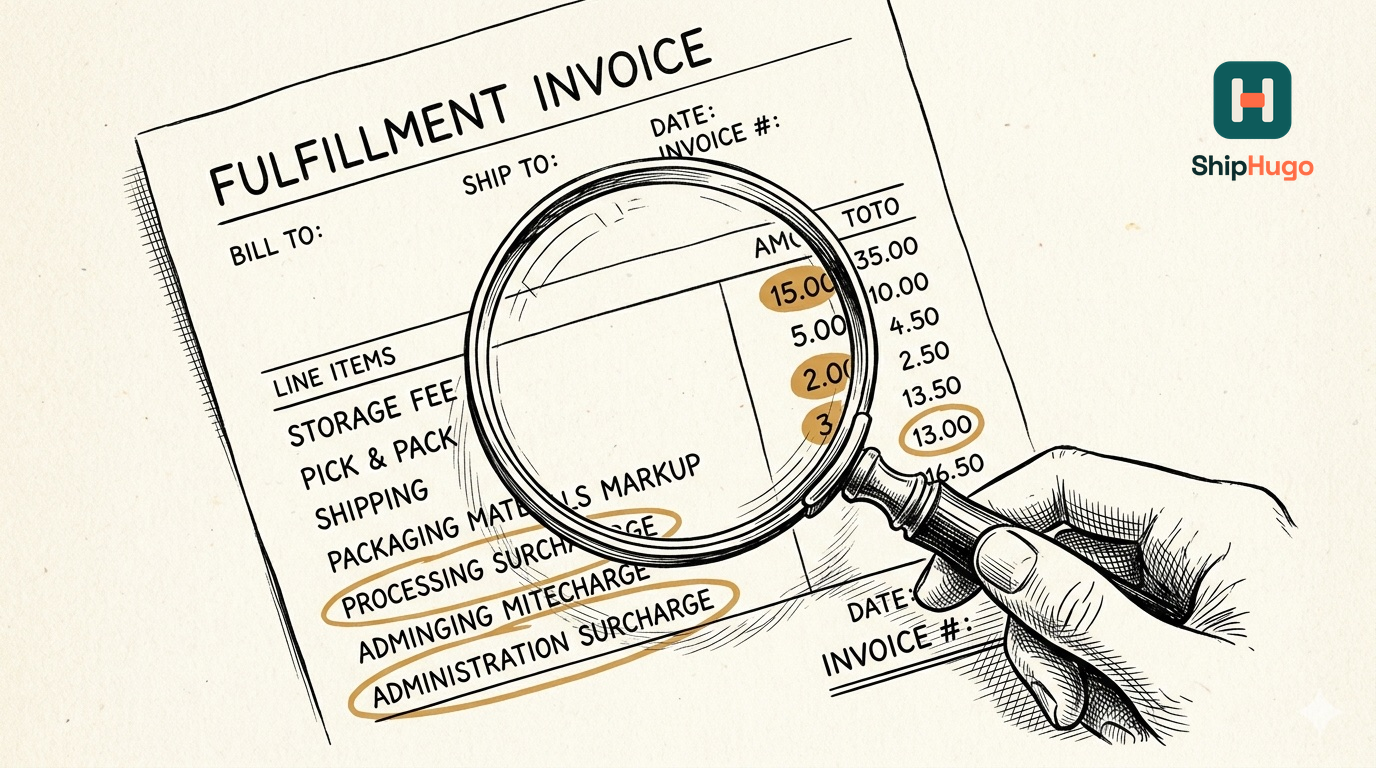
On top of that, since the toll reform, there are energy and toll surcharges wherever commercial trucks are involved, usually 0.30 to 0.80 euros per shipment. One provider itemizes it cleanly as its own line — with another it disappears into a catch-all bucket called “Other surcharges”. That right there is a warning sign of an opaque contract.
5. The cut-off
The cut-off marks the time by which an order still goes out the same day. 14:00 looks harmless, but it costs you real revenue: an order at 14:30 doesn't leave the warehouse until the next business day. On Black Friday or Cyber Monday, that means your “shipped today” promise only holds in the first hours of the day.
Professional warehouses run cut-offs until 17:00 or 18:00 — some, for a surcharge, even later. In the sales pitch, ask directly: “When does your carrier make its last pickup, and what does a later cut-off cost?” If no answer comes, there's no usable cut-off either.
6. What returns cost
A return isn't a shipment in reverse. It's a process in its own right: receive it, identify it, inspect it, decide on quality, put it back in stock or sort it out, trigger the refund in the shop, and refurbish it where needed. Serious providers charge 2 to 5 euros per return for this, depending on how involved it gets.
What many contracts leave open: who decides on putting items back into stock? Who pays for the special storage of damaged goods? And how quickly does your customer get their money back — within hours, within days, only at month's end? Points like these carry more weight in the negotiation than the bare per-unit price.
7. Setup fees, minimum revenues, contract terms
Three items that almost never appear on the first invoice — and hit all the harder when you exit:
Setup fees: onboarding, loading the master data, setting up the integrations. 500 to 2'500 euros is typical. Some providers drop the setup fee and recoup the money through higher per-unit prices in the first year. Both approaches are fine — what matters is that it's out in the open.
Minimum revenues (minimum volume commitment): “Below 1'000 shipments a month, a flat 1'500 euros applies.” In B2B such clauses are standard, but they hurt as soon as volume drops off — say after Q1, once peak season is over.
Contract terms: 12, 24 or 36 months are common. Three-year contracts should set off the alarm bells — they chain you to a provider whose service quality can slip noticeably within a single year. A six-month notice period makes it worse. Someone who gives you 24 months with three months' notice is in line with the market. Someone who insists on 36 months with six is out to pin you down.
How to spot a fair offer
In 90 percent of cases, three traits separate the pro from the pretender:
- Every item stands on its own. Pick, pack, shipping, storage, returns, surcharges — each as a separate line. An all-inclusive flat price without a breakdown is almost always a blended calculation with margin hidden somewhere.
- Carrier rates in their own column. That's how you tell whether your fulfiller passes on the carrier surcharges or keeps them as profit. Someone who sells you the DHL rate with 1.50 euros of margin on top isn't a logistics partner — they're a reseller.
- A sample invoice across three volume scenarios. Ask for a calculation for 500, 2'000 and 5'000 shipments a month — with every line item. Anyone who doesn't send that within 24 hours won't deliver snappy service in day-to-day operations either.
The bottom line
Pick & Pack is only the tip. Goods-in, storage by volume, the volumetric weight, the carrier surcharges, the cut-off, returns and the contract mechanics — those are the seven places where margin disappears, and almost always on the quiet.
An honest offer lays out all seven items for you, separated and with logic you can follow. If that's missing, the provider either doesn't have it under control or doesn't want to show you. Either way, a good reason to keep looking.
Want to know what you're really paying?
With us you get an all-in offer with no margin traps.
Book a 15-min intro callThis post comes from the ShipHugo editorial team. Questions about your specific case? Talk to us.