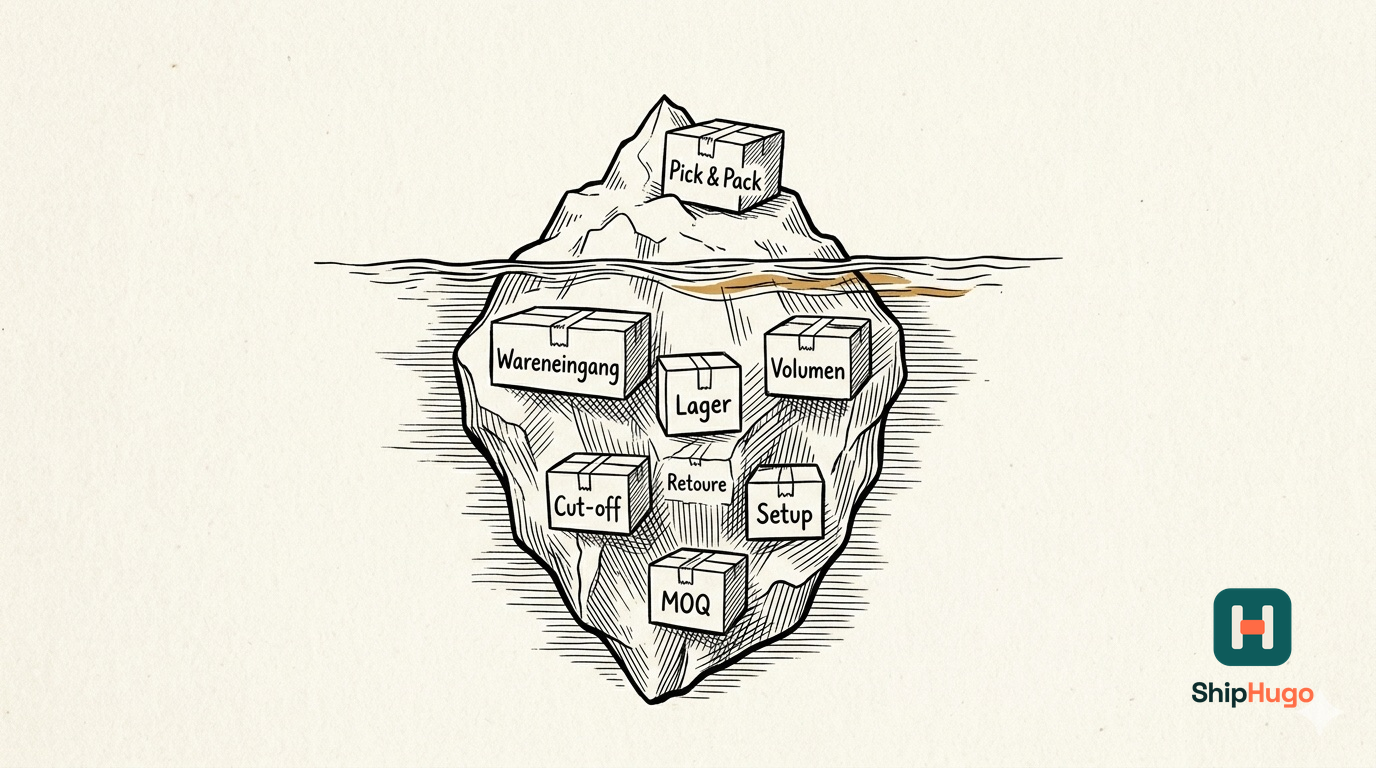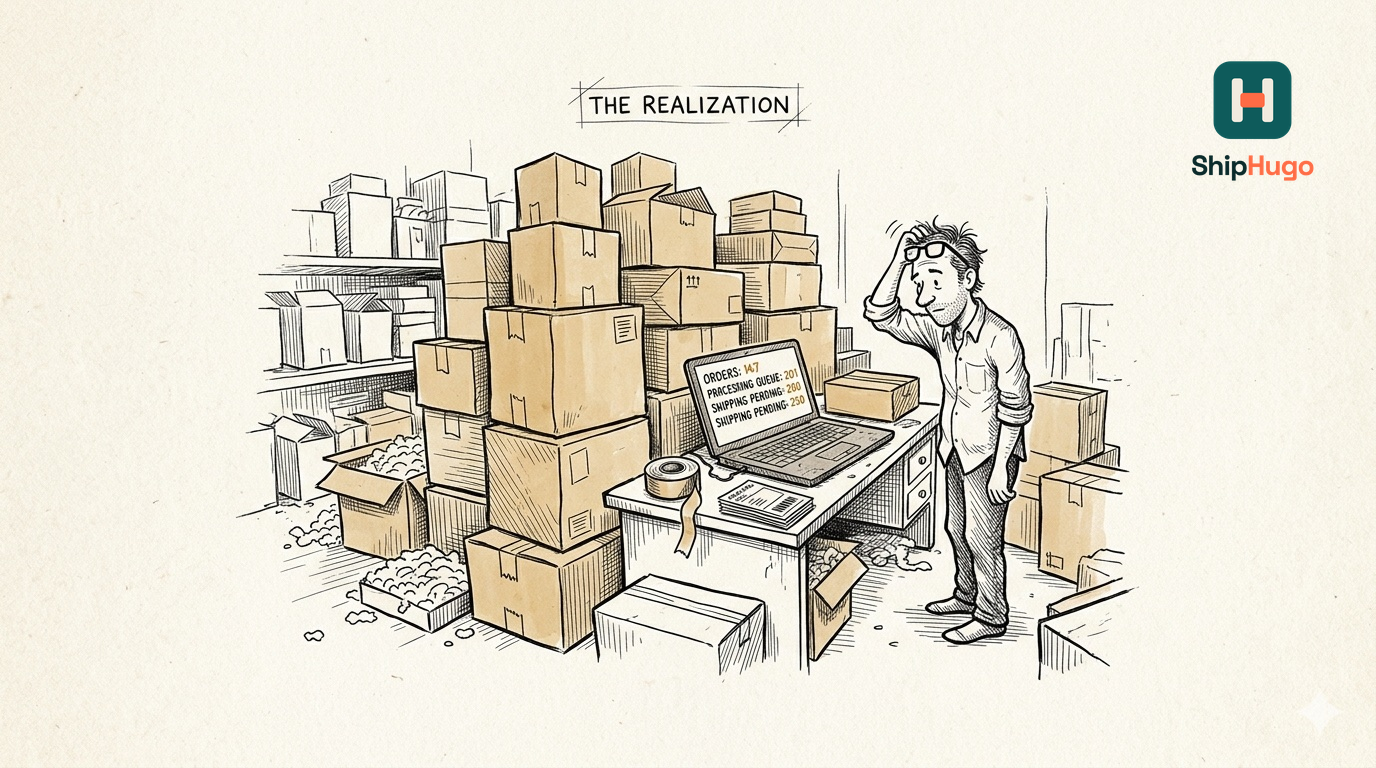
In just about every guide on shipping, you'll read the same sentence: “Outsourcing pays off once you hit 100 orders a month.” There are two catches with that. First, the rule holds true only in the rarest of cases. Second, it aims at the wrong question.
Whether outsourcing pays off isn't decided by any single order count. What matters is which tasks you're better off handing over — and where you're currently cross-subsidizing yourself without even noticing.
Why the standard answer leads you astray
Break 100 orders a month down for a moment: that's three orders a day. A motivated founder handles that easily in the gap between two phone calls. Outsource at this stage and you throw away margin with nothing to show for it. But the reverse is just as true: a shop with twelve orders a day, but 800 SKUs (stock keeping units) and its own packaging for every order, will run itself into the ground at just 360 shipments a month.
Volume is only one factor among several. The other three regularly get short shrift in the usual guides.
The four real triggers
First: time. Not the time at the packing table, but opportunity time. If you as a founder spend 15 hours a week in the warehouse, those exact 15 hours are missing elsewhere — in marketing, in product, in purchasing, in negotiations. So the real question isn't “What does fulfillment cost?” but “What does your time earn when you put it into something else?” — and in the early phase the answer is almost always well above 5 euros per shipment.
Second: cash flow. Store it yourself and your money is tied up in materials, in shelf space, in packaging stock. That's capital sitting idle. A fulfillment partner structures these costs differently — you're billed by volume, not by stock on hand. Free up 3'000 euros of working capital every month during your growth phase, and you can put that money into advertising. That outweighs any per-unit fee you'd save.
Third: the scaling plateau. At some point you reach a stage where every further step of growth brings more pain than payoff. One more packing table, one more temp, one more delivery van — and suddenly you're an operations manager instead of an entrepreneur. Cross this plateau without feeling it and you end up outsourcing two years too late. The decisive question: At what point does the added benefit of one more in-house hire slip into the red?
Fourth: quality costs. Mixed-up shipments, missing inserts, crooked labels. Every complaint drags you down by at least 20 euros — return, reshipment, time in support, a scratch on your rating. At an error rate of 1 % and 600 shipments a month, that adds up to 120 euros in complaints, plus the damage to your reputation. Professional warehouses stay below 0.2 %.
When the timing is too early
You should steer clear of outsourcing when:
- Your SKU-to-volume ratio doesn't add up. 500 items at 200 orders a month means barely 0.4 orders per SKU a month. At a fulfiller, storage costs grow with the number of slots — so you're paying for half-empty shelves.
- You pack every order individually. Personal greeting cards, handwritten notes, custom folded dimensions. A professional warehouse won't take that on at all, or only at per-unit prices that swallow your margin whole.
- Your margin stays below 30 %. Fulfillment runs 1.50 to 5 euros per standard shipment. If you make only 2 euros of margin per shipment, you simply can't afford it — for you it comes down to packing yourself, or to a fundamental question about the business model.
The hidden subsidy
This is exactly where the fallacy sits that costs many founders years: “I'll pack it myself, it doesn't cost me anything.”
But you're not packing for free. You pay with your own time, which you value far too cheaply. That way you're subsidizing your own shipping process, because you won't grant yourself the hourly wage you actually deserve. In the startup phase that's perfectly fine — but it stays a subsidy and not a real cost advantage.
The moment you use those hours for something that earns more than 5 euros per shipment, the math flips.
Concrete thresholds
Only at 200 to 500 orders a month does the question outsource or not even become interesting. Before that, it's usually not worth it.
From 1'000 orders a month on, in-house fulfillment is almost always the weaker choice — even when the numbers look right on paper. You're putting entrepreneurial energy into a process you could hand off, and that slows your scaling. Only one situation is the exception: highly customized specialty products whose quality no external provider can maintain.
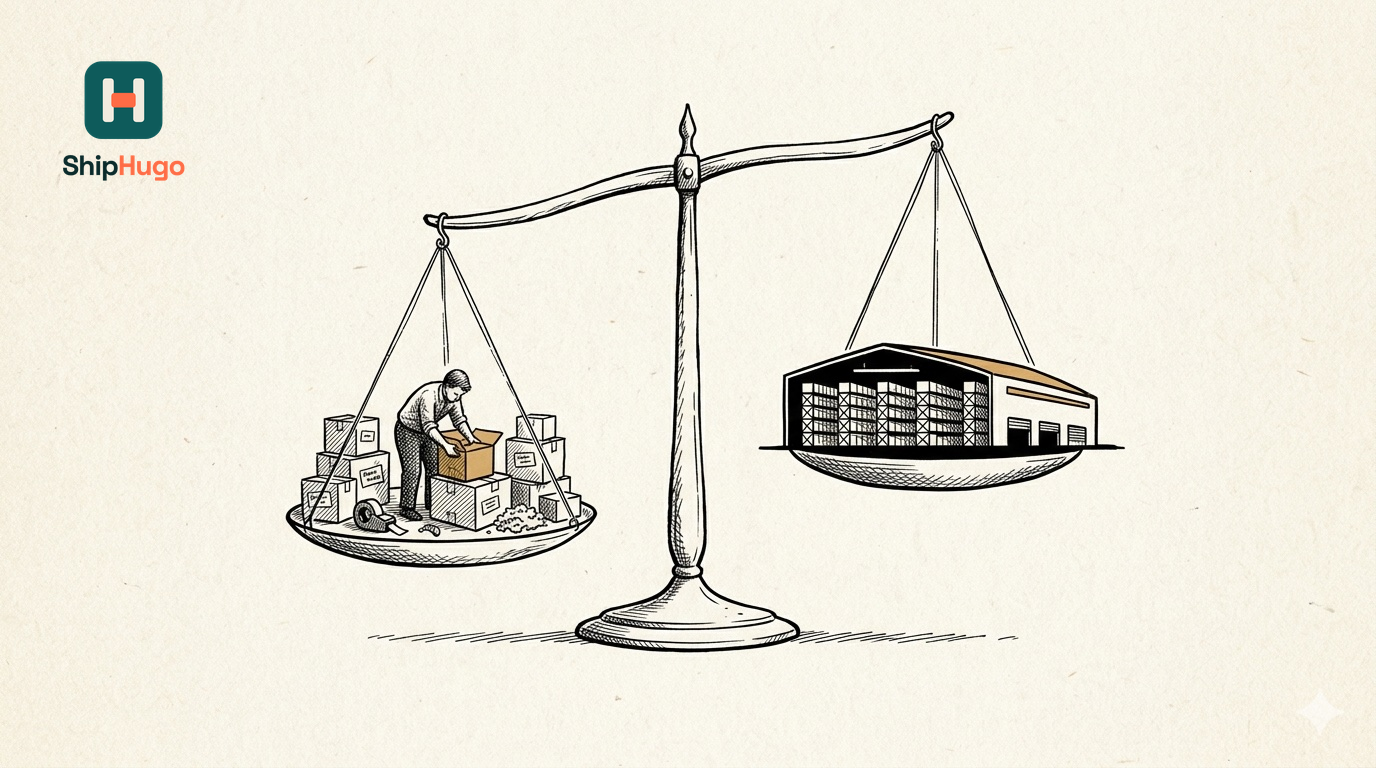
The range between 500 and 1'000 is the grey zone. Here the remaining factors tip the scale — time, cash flow, margin, and the variety of your SKUs.
Where outsourcing typically fails
Three classic mistakes, all of them avoidable:
Switching without clean master data. Start out with messy SKU lists, wrong weights, and dimensions that were never checked, and you'll find the same errors again at the new warehouse — only now in someone else's hands and harder to fix. So before the move: get your master data in order.
Ramped up too fast, checked too late. Have the first 200 shipments at the new fulfiller spot-checked, ask for photos, measure the error rate. Skip that and you'll only notice packing problems through customer emails — three weeks too late.
Signed the contract without paying attention to cut-off times. A cut-off at 14:00 seems harmless at first — until Black Friday arrives: everything that comes in after 14:00 doesn't go out until the next day. If you promise round-the-clock shipping, you have to lock it down in the contract.
The short version
If you wait for the 100-orders rule of thumb, you'll outsource either too early or too late. The right question is:
What is my own time costing me right now, what is my working capital tied up in, where does my growth tip over onto an operational plateau, and how much do error shipments cost me — all of it together, weighed against the per-unit price of an outsourced shipment?
If that sum comes out larger, hand off your shipping. If it's smaller, keep packing yourself. Both paths can be right — the rule of thumb, by contrast, only rarely.
Not sure whether you're ready yet?
In 15 minutes we'll sort it out — no sales pressure.
Book a 15-min intro callThis post comes from the ShipHugo editorial team. Questions about your specific case? Talk to us.