Few markets in Europe are as appealing to German online shops as Switzerland — and none causes as many logistical headaches. If your setup is missing even one piece, every parcel becomes a ball and chain: goods get stuck at customs, the tax office comes after you for back taxes, and your customer is hit with a surprise bill at the door. Here, with no marketing spin, is what German shops need to watch out for in 2026 when they ship to Switzerland.
Why the Swiss market really does pay off
Swiss customers have money to spend and send orders back less often. They buy a lot online, and the typical basket is noticeably larger than back home. If your shop delivers reliably — on time, with no nasty surprise at customs, with a Swiss shipping label — a market with above-average margins is waiting for you.
The crux sits in exactly that word: reliably. Because Switzerland is not part of the EU, there is no free movement of goods. Every parcel that crosses the border counts as an import. And since 2019, foreign senders have been subject to the same VAT rules as domestic retailers — provided they cross a certain threshold.
The 100'000 CHF threshold — and when it kicks in
The mail-order rule in Switzerland's VAT act kicks in as soon as you turn over more than 100'000 CHF (Swiss francs) a year in small consignments to private Swiss customers. A small consignment is any parcel on which no more than 5 CHF of import tax is due — that is, goods that used to cross the border tax-free because of their low value.
Once you cross the threshold, the place of supply shifts from the following month on: anything coming from abroad now counts as a domestic supply, and you owe Swiss VAT (value-added tax). That means you must register with the ESTV (the Swiss Federal Tax Administration) and appoint a fiscal representative based in Switzerland. No fiscal representative, no registration. No registration means fines, late-payment interest and, in the worst case, shipments blocked at customs.
There is no way around this threshold — it is binding, not negotiable. Anyone who crosses it and stays quiet gets found out eventually, because the ESTV compares import data against estimated turnover.
VAT rates 2026
There are three rates that have stayed the same since January 2024 and remain unchanged in 2026:
- Standard rate 8.1 % — for the bulk of goods
- Reduced rate 2.6 % — food, books, medicines, magazines
- Special rate 3.8 % — accommodation (barely relevant in e-commerce)
It's not calculated on the goods value alone. On import, the ESTV adds up goods value, shipping costs and any customs duties — and the tax rate is then applied to that total.
That's how the much-cited de-minimis limit comes about: if the tax amount stays below 5 CHF, no import tax is levied. At the 8.1 % rate that happens with a tax base of about 62 CHF, at 2.6 % at around 192 CHF. This gap was the foundation of earlier cross-border tricks — until Amazon overplayed its hand with book shipments broken into individual parts, and the mail-order rule arrived in 2019.
Customs — the Swiss special case
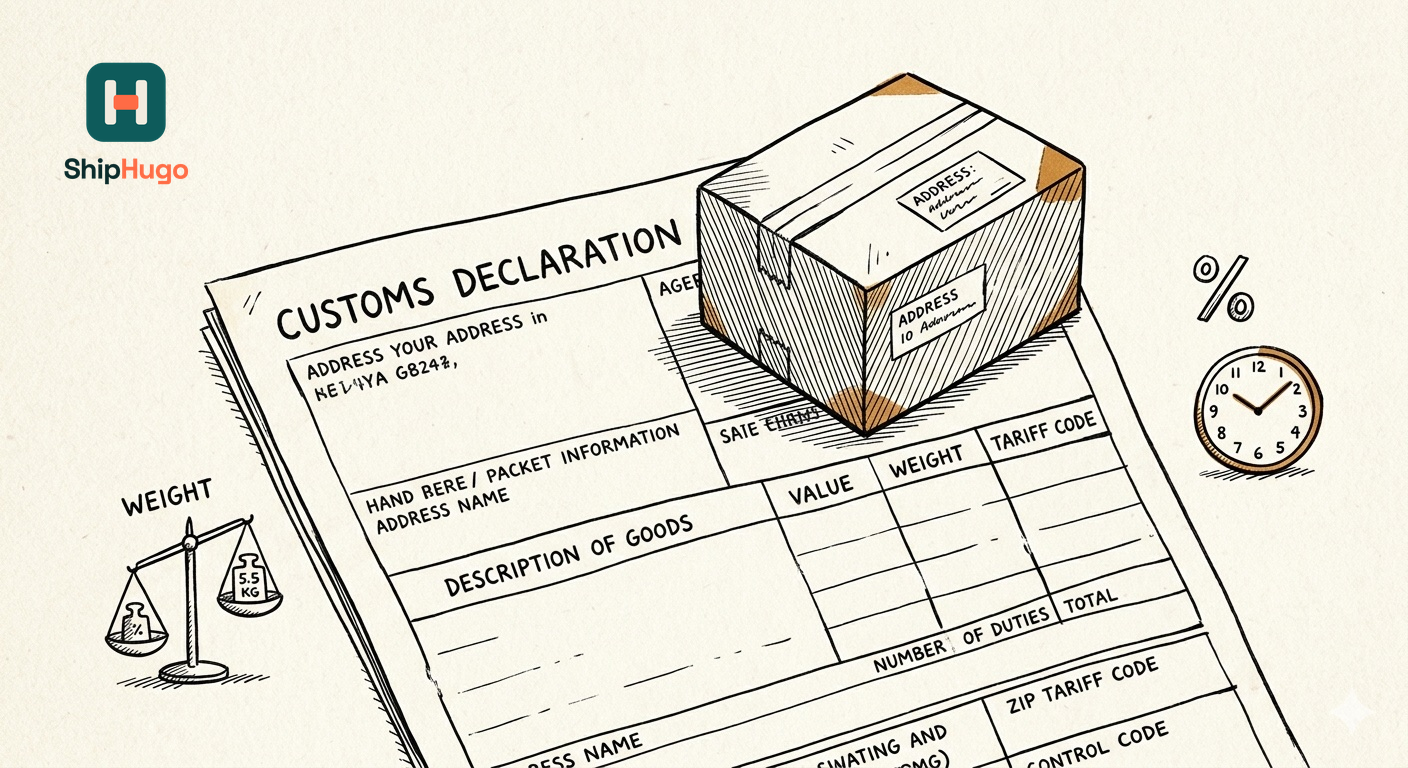
Unlike the norm, Switzerland assesses import duty by weight, not by goods value. This quirk exists nowhere else in Europe, and it astonishes everyone who hears about it for the first time.
In detail: the duty rate hangs on the customs tariff number (HS code, Harmonized System) and is usually quoted per 100 kg of gross weight. A piece of jewellery weighing 200 grams may well get through duty-free. A 5 kg box full of clothing, on the other hand, costs anywhere from a few rappen to several francs per parcel, depending on the tariff number. With textiles in large volumes, that adds up.
Every shipment must include:
- A commercial invoice in a clear sleeve on the outside of the parcel — without it, the parcel disappears into the customs process
- The customs tariff number (HS code) for each item
- Country of origin
- A goods description in readable plain text — no article numbers, no codes
If you bundle your parcels (daily import: a day's collected orders are cleared through customs together), the clearance fees per unit drop. But that only works if your carrier or fulfillment partner has a Swiss hub and has bulk customs clearance under control.
The ESTV's mail-order retailer list
If a retailer is liable for VAT in Switzerland, they show up in the ESTV's freely accessible UID/VAT list. There, Swiss customers can check whether a German shop is properly registered. That sounds like a footnote, but price-conscious buyers do it more and more often — because with an unregistered shop, the customer settles the import tax with the carrier, plus a clearance fee on top. Almost nothing leads to bad reviews from Swiss buyers more often than this: in the end they paid 25–40 CHF more than the checkout showed.
Fiscal representation — when it makes sense, when it's mandatory
It becomes mandatory the moment the mail-order rule makes you liable for tax. There's no way around it. The fiscal representative is your official point of contact with the ESTV, is based in Switzerland and handles correspondence, registration, quarterly returns and security deposits.
Even before you cross the threshold, the voluntary step via the declaration of subordination abroad pays off. Your supplies then count as domestic supplies straight away, and the VAT logic is uniform from the very first franc. That keeps your accounting and pricing clean — and spares you the break point where you'd otherwise have to switch over within 30 days.
Price-display obligation
In Switzerland, the Price Disclosure Ordinance (PBV) applies. The final price including VAT must be shown — net plus VAT only at checkout is not allowed in B2C (business to consumer). Anyone selling to private Swiss customers has to display their prices like a Swiss shop: gross, in CHF, unmistakably.
For your shop, that means, concretely: geo-detection, a dedicated Swiss storefront, or at least a separate price list with coherent VAT logic. Shopify, Shopware and WooCommerce can all handle it, but it has to be set up — out of the box it runs nowhere.
How a fulfillment partner with a Swiss warehouse handles all of this
With a warehouse in Switzerland — whether run yourself or through a fulfillment partner — you leave the cross-border world behind. You import only once, in bulk: your goods travel from Germany to Switzerland, are cleared through customs once, taxed once and put into storage. From then on, every parcel to Swiss customers is a purely domestic shipment — Swiss rates, Swiss shipping labels, delivery times of 24 hours, Swiss returns without the hassle of a re-import.
To the customer, your shop is then indistinguishable from a local provider. On the accounting side, you run a Swiss VAT registration like any other sender — but the effort per parcel vanishes into thin air. In return, you tie up capital in the warehouse and have to plan inventory.
It's not a question of whether, but of from when. As a rule of thumb: from around 200–300 parcels a month to Switzerland, the warehouse option starts to pay off — once you factor in the per-unit costs of customs clearance, the carriers' cross-border surcharges and the conversions lost to checkout shock.
In short
- 100'000 CHF in annual turnover from small consignments marks the threshold. Above it, registration is mandatory.
- Once registration applies, a fiscal representative is mandatory.
- 8.1 % standard rate, 2.6 % reduced. The tax base includes shipping costs.
- Customs duty is based on weight, not goods value. A tariff number for each item is mandatory.
- Commercial invoice on the outside, plain text, country of origin.
- Prices in CHF, gross, clearly recognizable.
- From 200–300 parcels a month, a Swiss warehouse pays off.
Deliver cleanly and you get above-average returns in the Swiss market. Deliver sloppily and you get the bill from the carrier or the customer — usually from both.
Want to expand into Switzerland without the customs headaches?
We warehouse right in Switzerland and take care of VAT handling and customs clearance.
Book a 15-min intro callThis post comes from the ShipHugo editorial team. Questions about your specific case? Talk to us.